Mastering Bird Photography on the Chobe
Feathers, Physics & Patience
Dave Dooley’s Field Notes from the Chobe River
There are two types of bird photographers: those who click a button and snap a well timed shot of birds, and then there are those who study them – patiently, obsessively, long before they ever lift a camera. David Dooley sits firmly in the latter. Time on the river with him uncovers a process that borders on fanatical; every variable considered, each movement anticipated, and the decision made before the shutter is ever pressed.
You will find that this is not a traditional blog. It is a distillation of fieldcraft, the kind that usually takes years to build, and even longer to articulate. For anyone who has returned from a shoot knowing the moment was there, but the image fell short, the answers often lie not in the camera, but in what came before it. Perhaps it was that the light was misread, key behaviour missed or even timing just a fraction too late.
On the Chobe, where the river adds to the complexity, where it becomes part of the equation, this understanding is amplified. The ability to reposition for light, anticipate movement with your guide, and work within an environment where birds are both abundant and remarkably tolerant, creates a wonderfully unique setting.?
This is a guide for those who want to understand why their images are not yet what they know they could be, and what it will take to change that. We caught up with Dave to find out more…
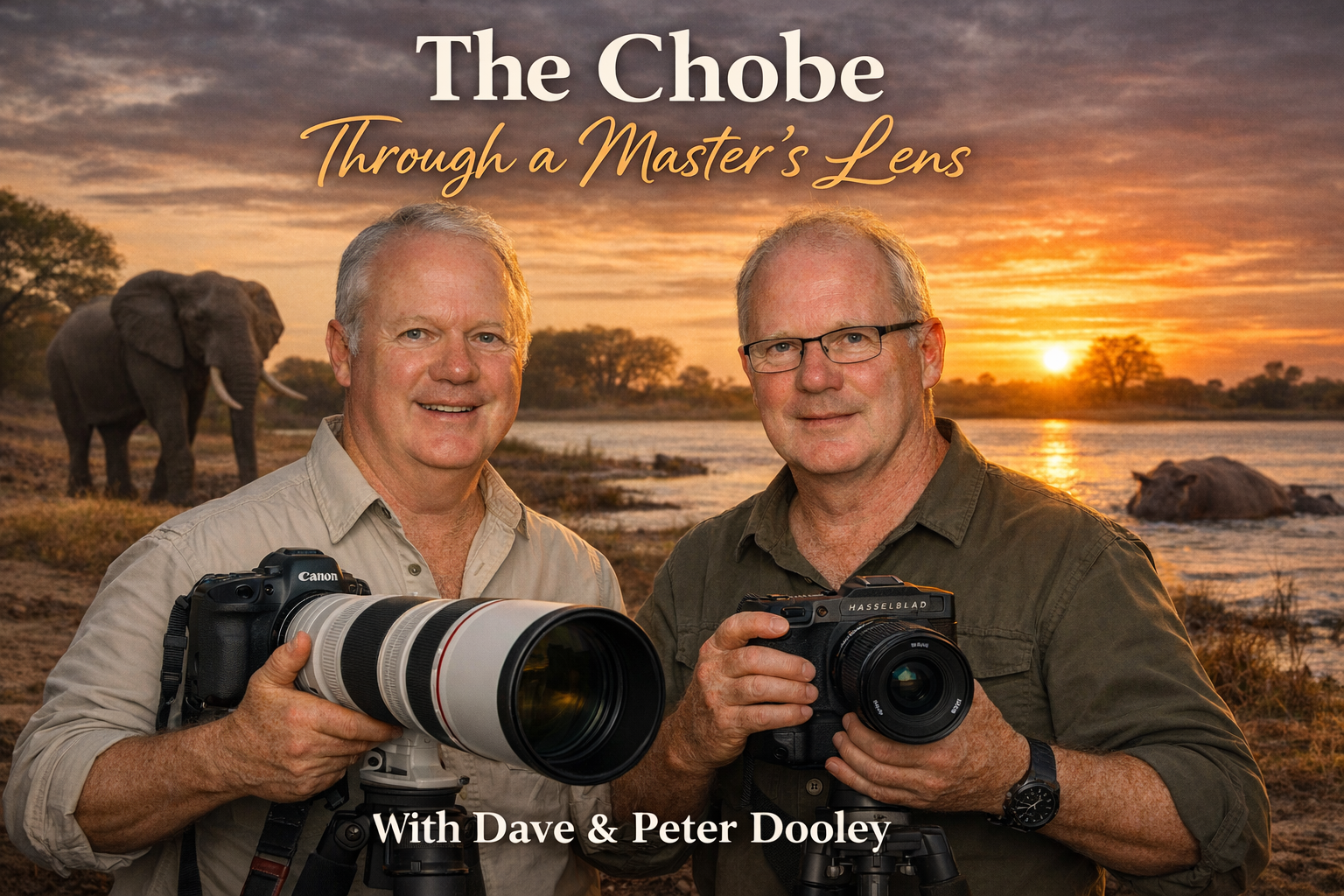
This is the second instalment in our series, The Chobe Through a Master’s Lens, anchored by the Dooley brothers’ deep experience on the river and their distinct specialisations: Dave with birds, Peter with landscapes.
Dave and Peter have just returned from a trip to the Chobe, have a look at their photos from their recent stay with us here.
Reading the Environment
Understanding the environment, light, movement, and how positioning shifts constantly, as well as how they interact is the foundation of every successful image.
Q: When you are on the Chobe at first light, what are you reading first?
Light, without question. At first light on the Chobe, reading the available light governs every exposure decision that follows. Its intensity determines lens selection: an f/2.8 for maximum light transmission, or an f/5.6 when conditions allow a smaller aperture and greater depth of field. It also establishes the boundaries within which shutter speed can be set.
Bird behaviour is the second variable. Paying attention to the activity level, whether birds are stationary or in flight, dictates the minimum shutter speed required to freeze motion, which feeds directly back into the aperture decision.
Where aperture and shutter speed cannot achieve a correct exposure, ISO can be introduced — but not above ISO 800. In low light the incoming signal is weak. Camera sensor noise is essentially fixed, so as signal decreases the signal-to-noise ratio deteriorates rapidly and image noise becomes unacceptable.
Shutter speed also has a hard lower limit governed by focal length: minimum shutter speed should not drop below 1/focal length. On a 400mm lens, 1/400s is the floor. At first light on the Chobe, this constraint is always in play.
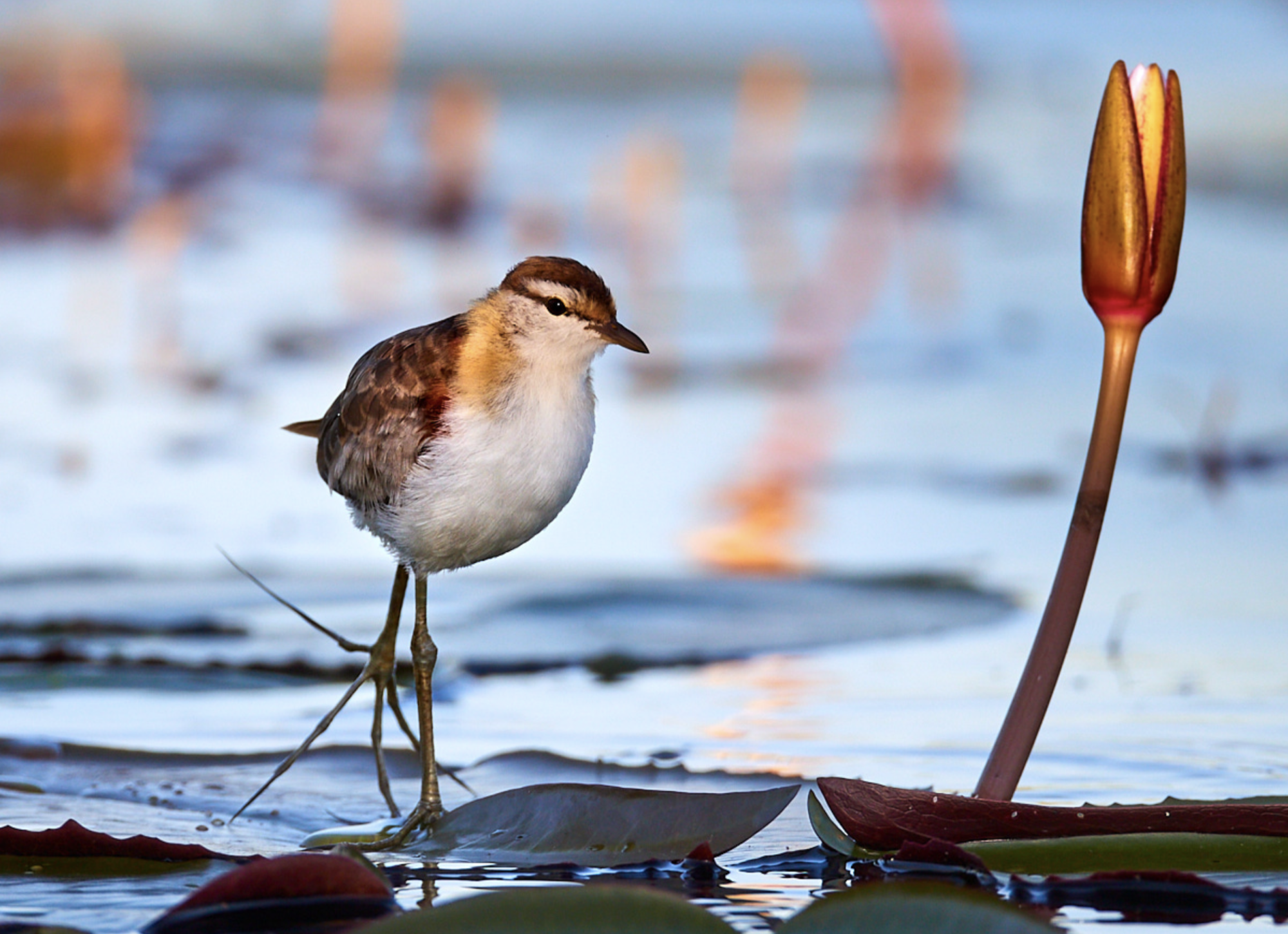
Lesser Jacana at Sunrise Image supplied by Dave Dooley
Q: What does the river allow you to do photographically that land-based shooting simply cannot?
Control. On a land-based setup such as a hide, your position is fixed. You have no ability to adjust composition, reframe for the light, or reposition relative to the subject. You shoot what you are given.
On the river, the boat is a dynamic shooting platform. The guide can reposition in real time across three variables simultaneously.
Light
The boat can be angled to optimise the angle of incidence of available light on the subject, maximising feather detail and surface texture. Early morning and late afternoon light is directional — placing the subject correctly relative to that light source is a significant technical advantage.
Composition
The guide can manoeuvre to control what appears in the background — reeds, sticks, open water, or bankside vegetation — placing compositional elements deliberately or clearing obstructions that would block key parts of the bird.
Wind
A skilled guide reads wind direction and positions the boat accordingly. Birds almost always take off and land into the wind. By anticipating this, the guide places the boat so that when the bird lifts, it flies toward the camera. On a fixed hide, if the bird tacks away you are left with a tail shot and no eye contact. On the river, that outcome can largely be engineered out.
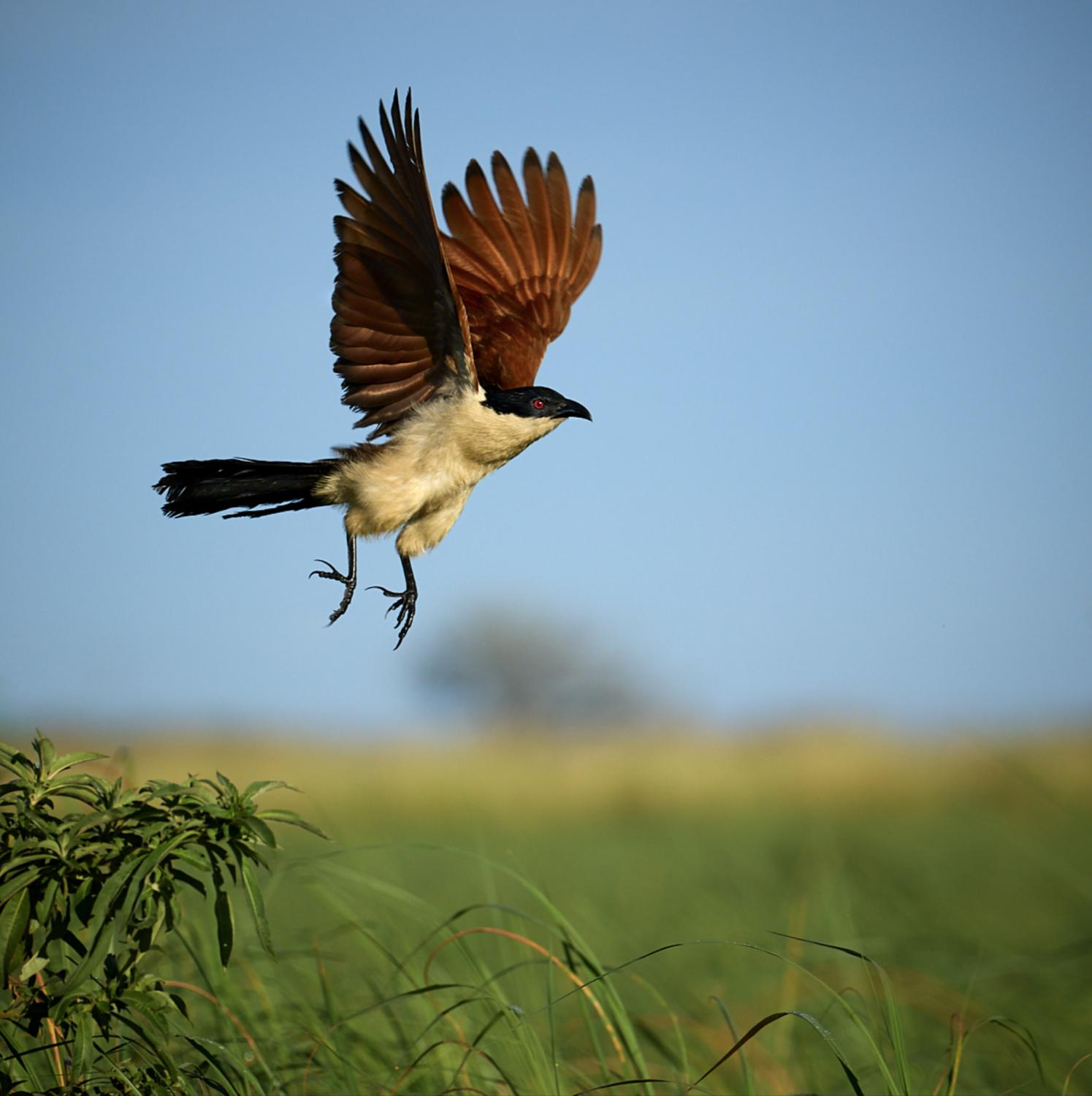
Coppery-tailed coucal taking off into the wind Image supplied by Dave Dooley
Q: How does being on a moving platform change your decision-making compared to being stationary?
On a stationary platform, exposure decision-making is largely front-loaded. You have time to dial in aperture and shutter speed before the bird arrives and make only minor adjustments as conditions shift. You can also shoot from a fixed tripod, monopod, or bean bag — removing camera movement as a variable entirely.
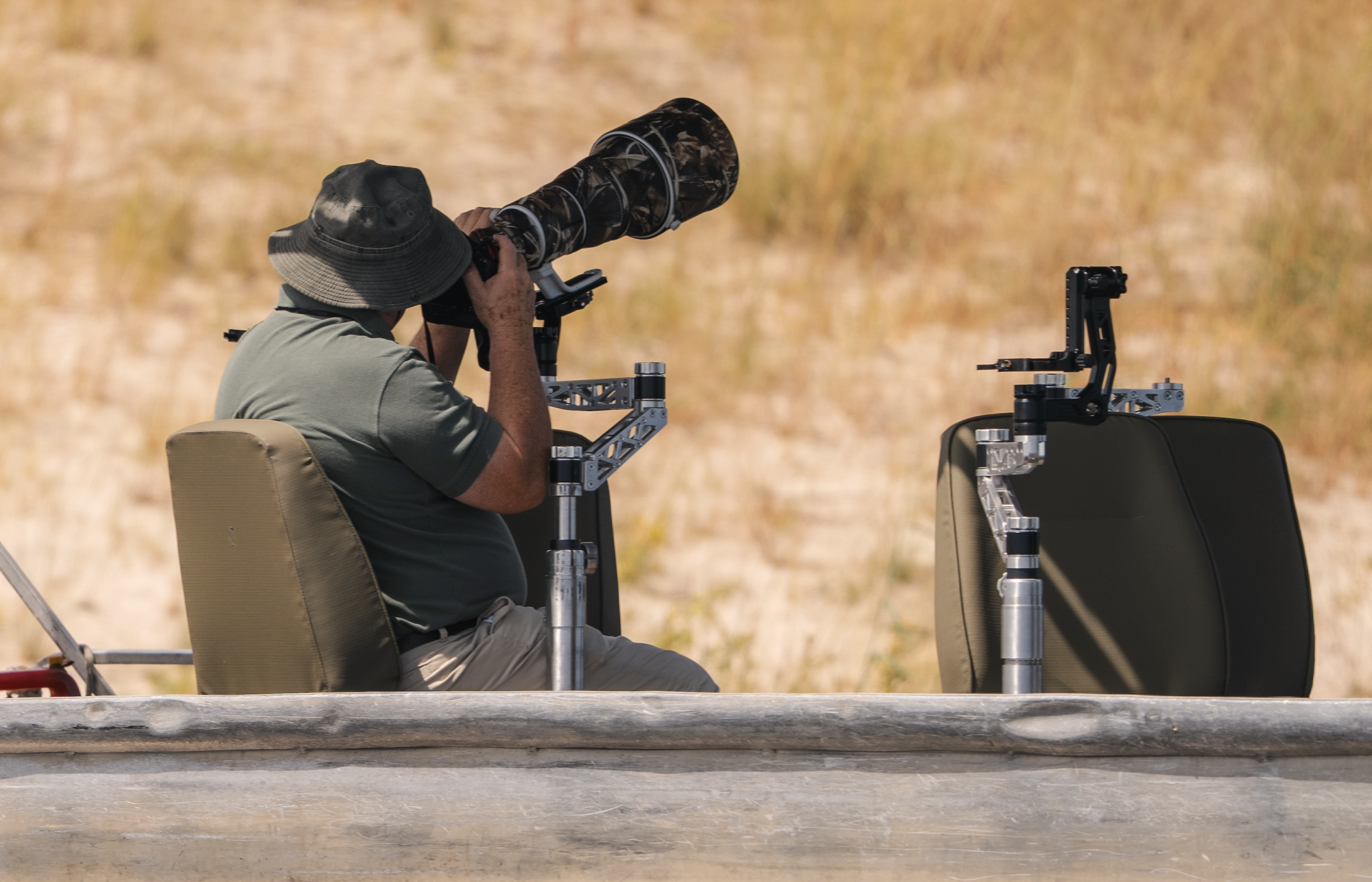
On a moving platform, none of those conditions hold. As the boat repositions, the angle of light changes continuously and exposure settings must be re-evaluated in real time. Camera movement introduces a second layer of complexity. The gimbal mounted on swivel seats absorbs lateral movement and allows smooth subject tracking, but the roll of the boat remains a genuine challenge that takes time to internalise.
Without a gimbal, shooting from a boat is a significantly more demanding physical proposition. Handholding a 400–800mm lens for extended periods is exhausting, and fatigue is a direct and underestimated cause of camera shake. The primary technical response to dampening boat movement is shutter speed — but identifying exactly what that speed needs to be under varying river conditions requires deliberate practice.
The Importance Of Understanding Behaviour & Prediction
The difference between a missed shot and a decisive one comes down to anticipation. By the time a bird takes flight, it is already too late. The work happens in the seconds before, in the subtle signals, shifts, and patterns that most photographers overlook.
Q: What are the earliest signs a bird is about to take flight that most people miss?
This is arguably the most important skill in bird photography, and almost entirely unrelated to camera technique. By the time most photographers react to a bird launching, the shot is already lost. Anticipation comes from reading behaviour, not reacting to movement.
Defecation
The earliest and most reliable signal. Birds defecate before flight as a matter of physiology. Once you have seen this on the Chobe you will never ignore it again. You have perhaps three to ten seconds.
Feather compression
Immediately before launch, a bird compresses its feathers tightly against its body — the opposite of the puffed, relaxed posture of a settled bird. Subtle but visible at long focal lengths.
Head and neck movement
A bird preparing to fly scans with increased urgency — rapid, deliberate head turns, looking into the wind to confirm its intended flight path.
Weight shift and leg flex
Just before takeoff, the bird shifts its weight forward and flexes its legs, loading them for the explosive push of launch. On larger birds — Herons, Egrets, Fish Eagles — this postural shift is clearly visible.
Wing micro-lift
In the final fraction of a second, many birds produce a barely perceptible lift of the wingtips. By the time the wings are visibly opening, the shot is already in motion. The photographer who waited for this moment is already behind.
Technical preparation and what must already be done
Reading pre-flight behaviour is only half the equation. The tracking system must be locked onto the bird while it is still on the perch. Exposure must be confirmed before the event. Aperture must be adjusted for the increased depth of field required when the wings extend in flight — not in reaction to it.
Finally, the guide must have the boat at the correct distance. A bird with wings fully extended at launch can span a very large portion of the frame. A clipped wingtip is one of the most avoidable errors in bird-in-flight photography and signals to any informed viewer that the photographer was not ready.
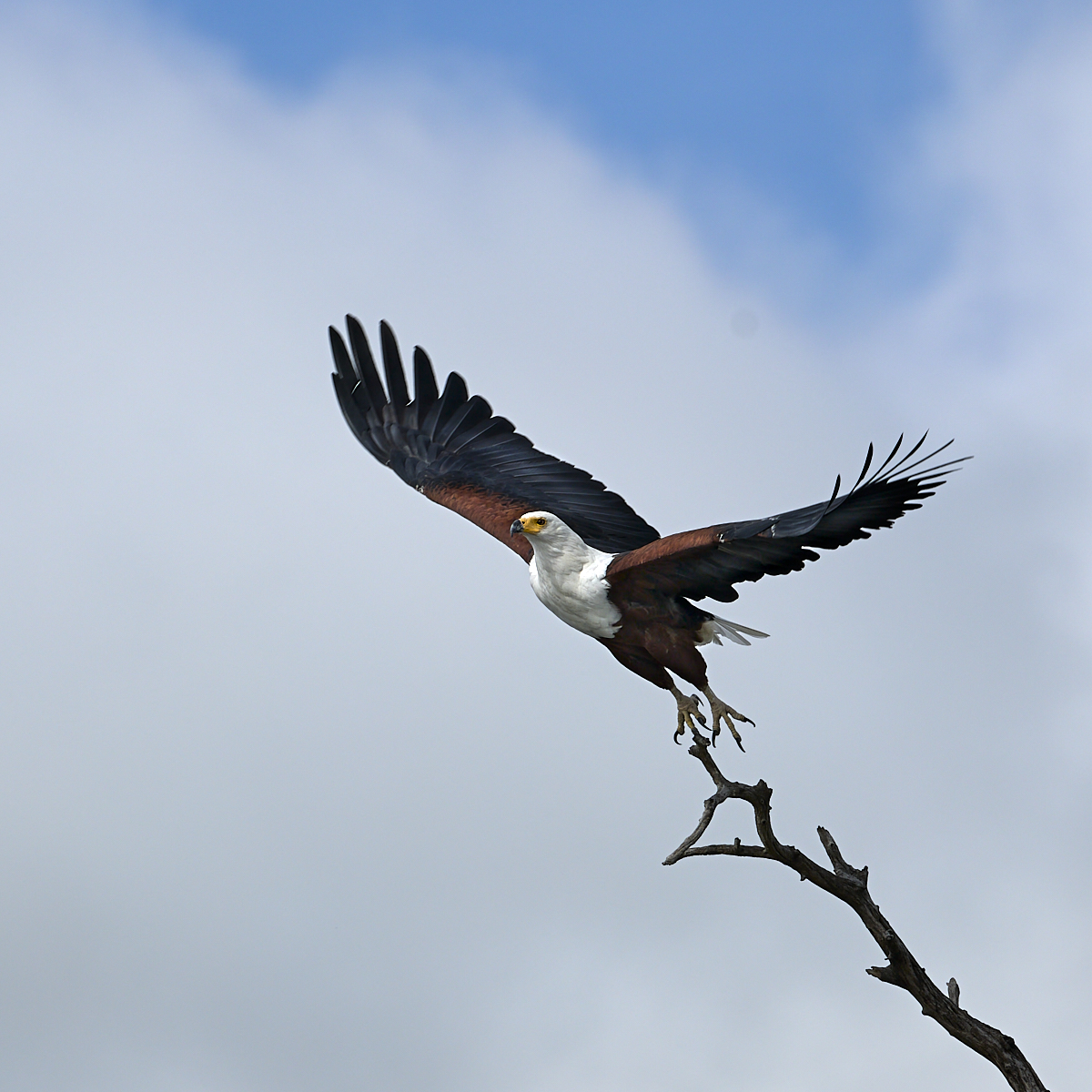
African Fish Eagle Image supplied by Dave Dooley
Q: How do you predict flight paths on water, what cues are you watching?
Predicting flight paths combines reading the bird, reading the wind, and understanding the river geography. Get all three right and the bird flies toward you. Get any one wrong and you are photographing tail feathers.
Wind direction – The primary cue. Birds take off and land into the wind universally. The guide reads wind direction continuously and positions the boat so the bird launches toward the lens.
Perch orientation – A bird that has rotated to face into the wind has made its decision. The flight path is confirmed. Combined with active head scanning, this is a precise directional signal.
River geography and habitat –Birds follow the path of least resistance. Herons follow water edges, Fish Eagles track the river corridor. Understanding the habitat removes much of the guesswork.
Species behaviour – Different species have characteristic flight patterns. Kingfishers fly fast and low. Herons climb steeply then level out. Fish Eagles bank in a wide arc on departure. Knowing the species tells you not just direction but altitude and speed.
The guide’s role – Predicting flight paths on the Chobe is a two-person discipline. The photographer reads the bird. The guide reads the wind and water and moves the boat. The best bird-in-flight shots are the product of that collaboration.
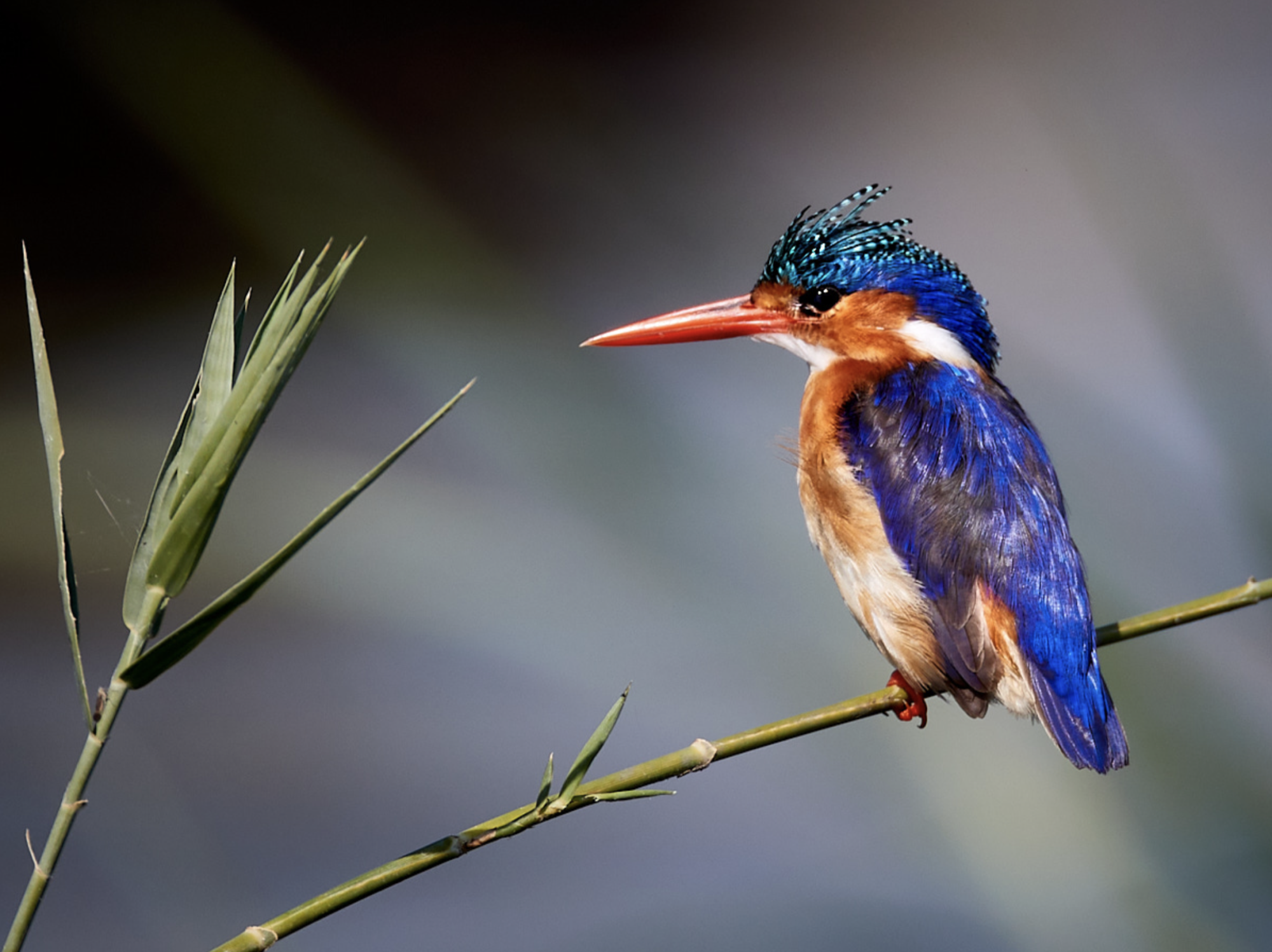
Malachite Kingfisher Image supplied by Dave Dooley
Q: Are there specific species on the Chobe that are more ‘readable’ than others? Why?
Yes. Readability comes down to body size, behavioural predictability, and habitat preference. Large birds that favour open, exposed perches and follow consistent patterns are the most readable.
Most readable
The African Fish Eagle is the benchmark prominent perches, visible pre-flight signals, predictable river corridor flight paths, and strong territorial habits that return it repeatedly to the same trees. The guide learns the perch before the bird lands.
Goliath and Grey Herons are similarly readable: large, slow to launch, with a pronounced weight shift that gives ample warning. Darters and Cormorants require a long water runway to become airborne, making launch point and direction almost entirely predictable.
Least readable
Kingfishers are the most challenging. The Pied Kingfisher launches with almost no pre-flight signal, flies fast and low with rapid directional changes, and is small enough that tracking at speed is genuinely difficult. Bee-eaters present a similar challenge – fast, agile, prone to sudden mid-flight direction changes that defeat well-configured tracking systems.
The practical implication
Develop technique on the readable species first. Master pre-flight signals, tracking acquisition, aperture management, and boat positioning on Fish Eagles and large Herons. The fast and unpredictable species will still be there when those fundamentals are locked in.
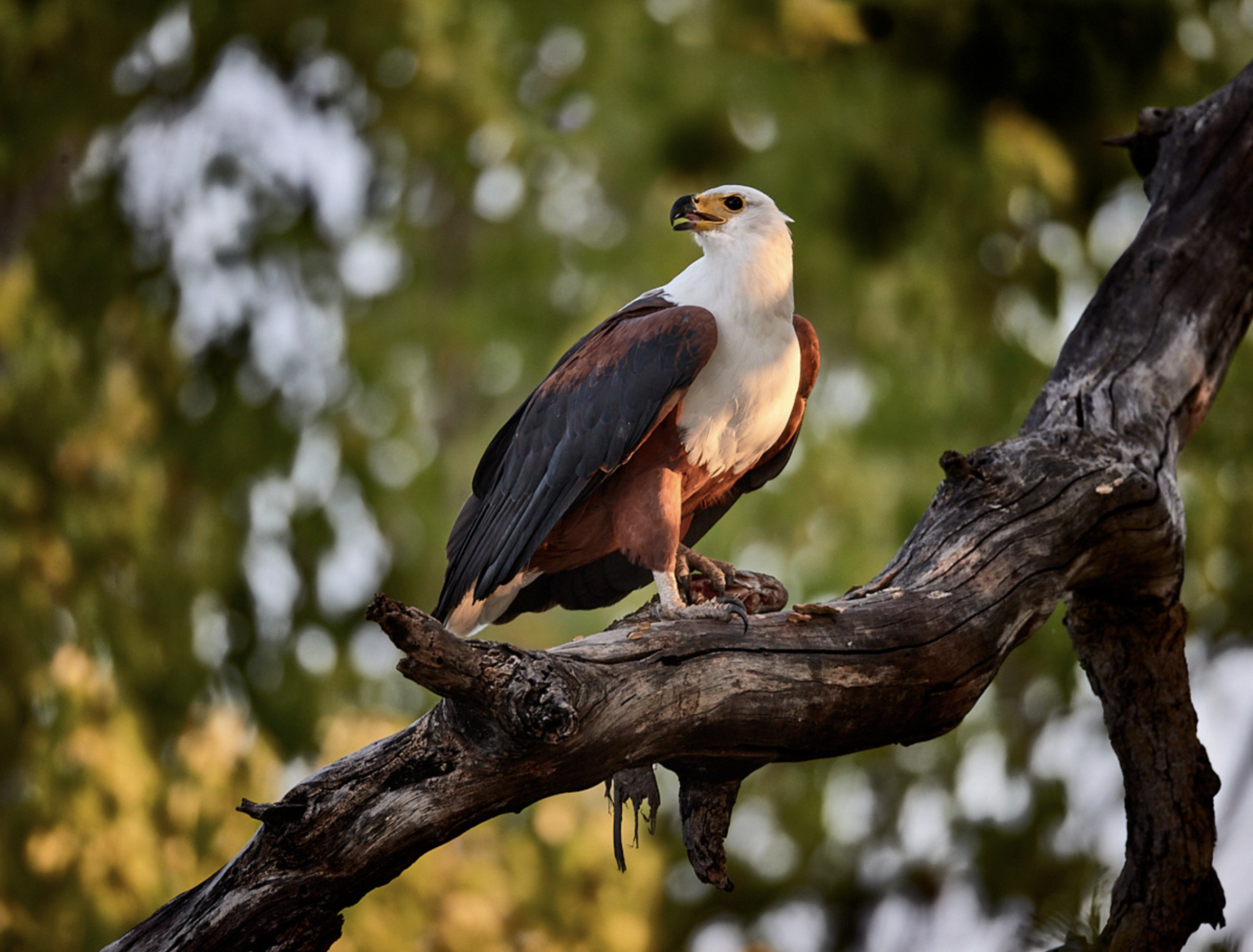
African Fish Eagle Perched with Catch Image supplied by Dave Dooley
Q: Have you ever completely misread a moment?
Honestly, no. Misreading moments is largely a preventable failure. Every destination I visit is preceded by serious research into species behaviour: flight patterns, hunting habits, pre-flight signals, territorial behaviour, preferred perches, feeding times. By the time I am on the boat, the birds are not surprising me. I am waiting for things I already expect to happen.
The lesson for other photographers is straightforward: know your bird before you photograph it. A camera is not a substitute for knowledge. Field craft begins in the library, long before it begins on the river.
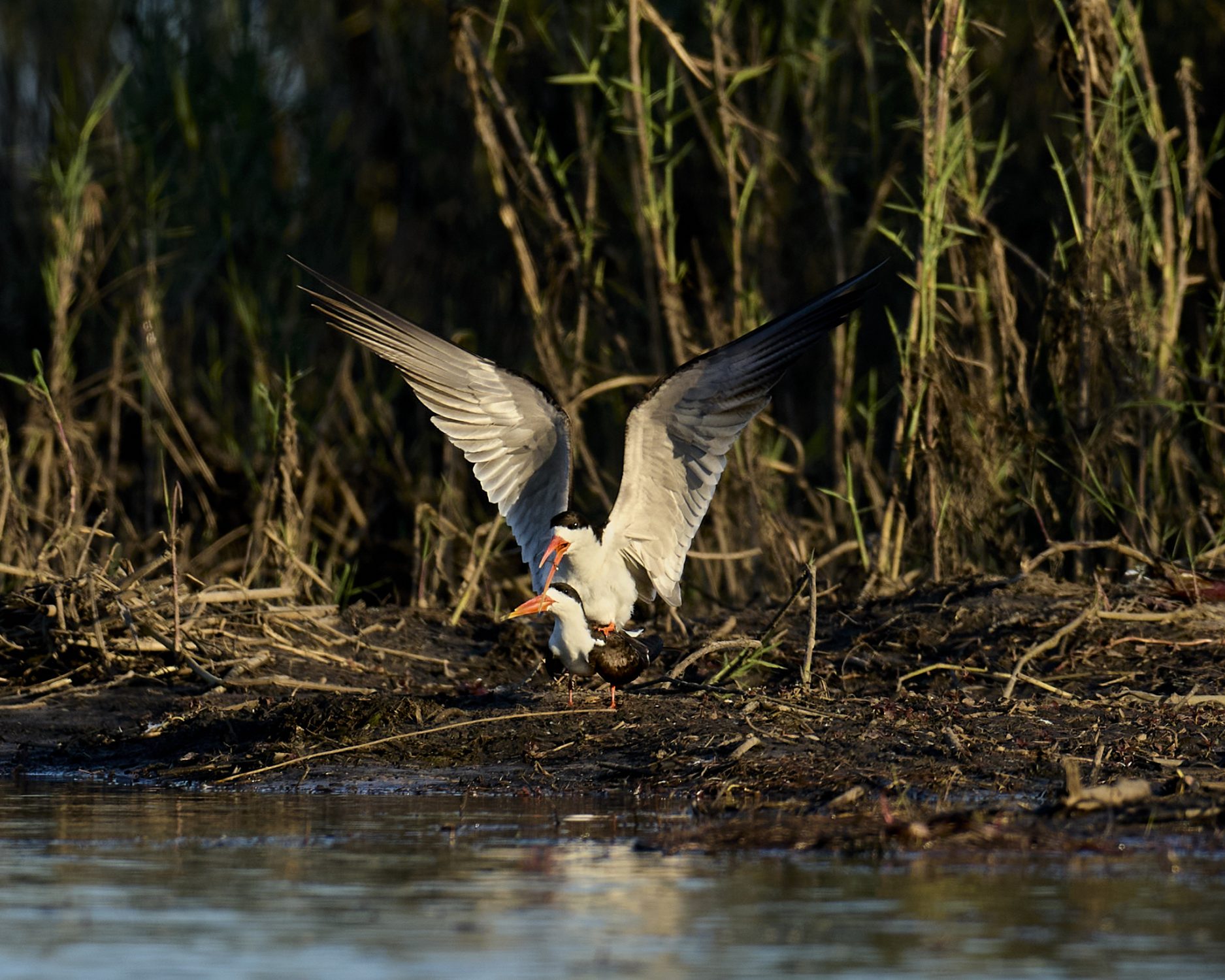
African Skimmer pair bonding in daylight Image supplied by Dave Dooley
The Effect Of Light, Wind & Water
On the Chobe, light, wind, and water are constantly interacting elements that introduce a level of complexity that cannot be controlled, only managed. Reading how they shape exposure, movement, and positioning in real time is fundamental to the outcome of every image.
Q: How does glare off the river affect your exposure decisions in real time?
Glare off the water is one of the most technically demanding challenges on the Chobe and changes continuously as the boat moves and sun angle shifts.
The problem
Water reflects direct sunlight with an intensity that can exceed the dynamic range of any sensor. When glare enters the frame the sensor must simultaneously expose for an extremely bright surface and a correctly lit bird. It cannot do both.
The exposure decision
Expose for the bird always. A correctly exposed bird against a blown highlight is recoverable and often beautiful. An underexposed bird against a correctly rendered water surface is neither. Watch your histogram in real time — not the screen. A spike hard against the right edge indicates blown highlights. If they are as a result of specular highlights created by water, continue shooting. If they are creeping into the bird, reduce exposure immediately.
Polarising filters
A circular polarising filter significantly reduces surface glare by blocking horizontally polarised reflected light. The trade-off is a light loss of approximately 1.5–2 stops, which must be compensated through aperture, shutter speed, or ISO within the constraints already discussed.
Boat positioning
The guide is part of the solution. Repositioning to change the angle between sun, water, and subject can reduce glare dramatically without any camera adjustment. Shooting with the sun behind or beside you eliminates the worst reflection entirely.
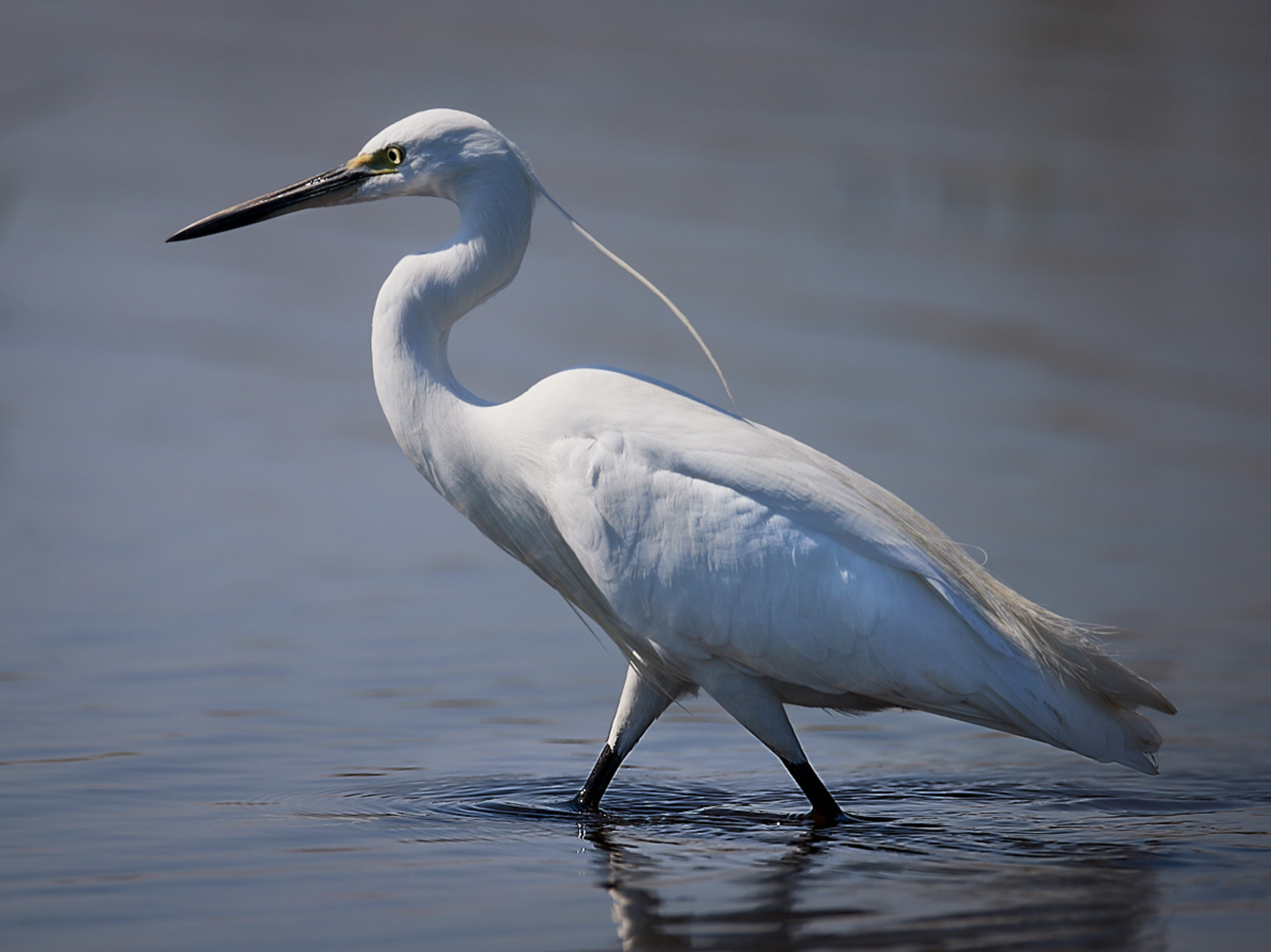
Little egret with courtship feathers on display. Image supplied by Dave Dooley
The photographic boat
Q: Do you expose for the bird, the water, or the highlights – and how do you balance that?
Expose for the bird, always. The subject is non-negotiable. The tonal challenge on the Chobe is extreme, a dark cormorant against bright reflective water can represent a dynamic range exceeding 10 stops. A white egret against the same background presents the opposite problem.
Dark species
Expose to the right, push exposure as far as possible without clipping highlights on the bird itself. Shadow detail on dark feathers is recoverable in post processing. Blocked shadows are not.
Light or white species
Pull exposure back sufficiently to retain feather detail in the brightest areas. A white egret with blown plumage has lost all texture. Protect the bird’s tonal detail above everything else. Highlights on the water are irrelevant.
The histogram is the reference
The screen is unreliable in bright conditions. Watch the histogram, identify where the subject’s tones sit, and expose accordingly. Good exposure on the Chobe is as much about what you deliberately sacrifice — blown water highlights, compressed background shadows – as what you protect.
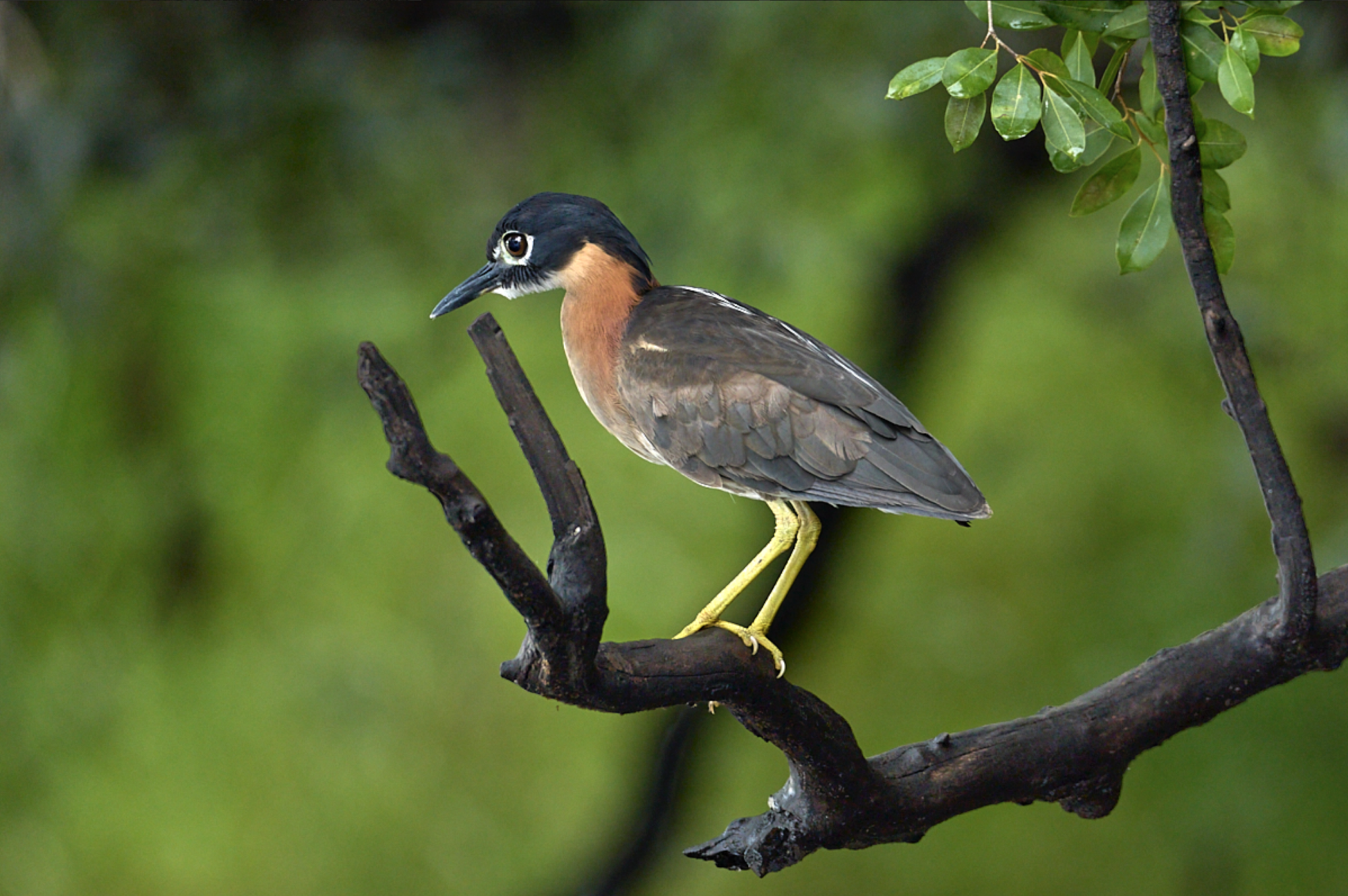
White-backed night heron. Image supplied by Dave Dooley
Q: How does wind direction influence where your guide positions the boat?
Birds take off and land into the wind without exception – it is aerodynamic necessity. A skilled guide reads wind direction continuously and positions the boat so that when the bird launches, it flies toward the camera rather than away from it.
A bird facing into a westerly wind will launch westward. The boat must be to the west. Get that right and you have a bird flying into your frame with its breast, face, and full wingspan presented to the lens. Wind direction also determines flight path predictability, which feeds directly into framing, tracking, and aperture decisions. Everything on the Chobe connects back to wind.
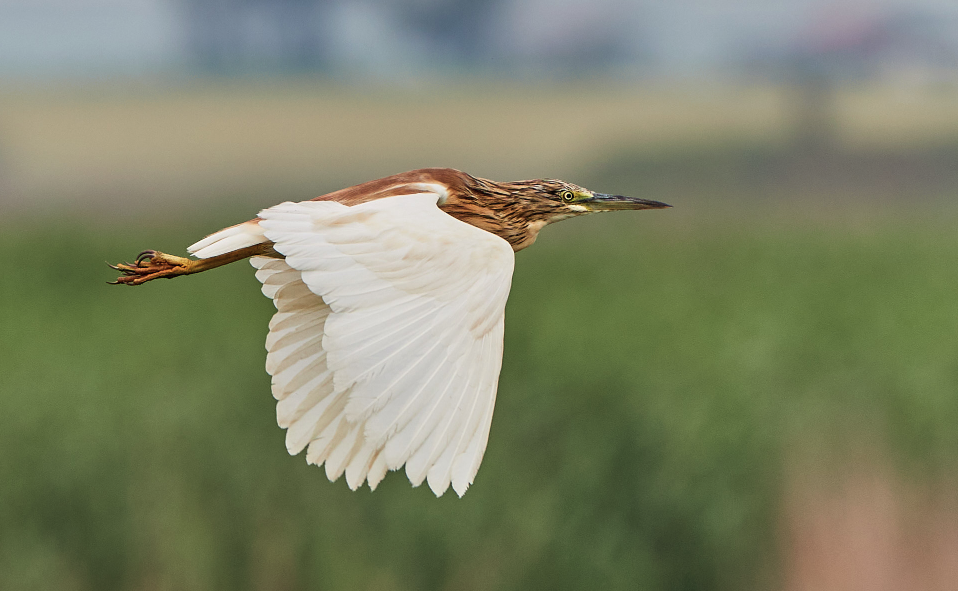
Squacco Heron in flight Image supplied by Dave Dooley
Shooting In Motion
Shooting from a moving platform introduces a different level of complexity. The moment a bird takes flight the margin for error disappears. On the Chobe, where both boat and subject are in motion – sharpness is no longer a given but needs to be actively managed through instinct, precision, and timing.
Q: What changes in your camera setup when you’re shooting from a boat versus land?
Almost everything, and the changes are non-negotiable.
Support system
On land, a tripod, monopod, or bean bag removes camera movement as a variable. On the boat, the gimbal on the swivel seat is the primary support system. Without one, handholding a 400–800mm lens for extended periods produces fatigue — and fatigue is a direct and underestimated cause of camera shake and lost shots.
Shutter speed
Platform movement adds an independent source of motion blur to subject movement. The minimum viable shutter speed on a moving boat is significantly higher than on land for the same lens and subject.
Autofocus configuration
Continuous tracking autofocus must be active at all times — including while the bird is perched. Acquiring tracking focus on a bird already in flight is unreliable. Lock on before launch.
Aperture
Anticipate the transition from perched to airborne and set aperture for the increased depth of field required to keep an extended wingspan sharp across its full span.
ISO discipline
The higher required shutter speed places greater pressure on ISO than land-based shooting. The ceiling of ISO 800 remains fixed, but the boat will push you toward it more frequently.
Q: How do you maintain sharpness when both you and the subject are moving?
This is the central technical challenge of boat-based bird photography and is managed through equipment, technique, and preparation working simultaneously.
Shutter speed
Shutter speed does the heaviest work. It must arrest both platform and subject movement independently. For birds in active flight from a moving platform, shutter speeds of 1/2000s and above are the norm.
The gimbal
The gimbal absorbs lateral roll and yaw, allowing smooth subject tracking. Without one, handholding a long lens on a moving boat produces fatigue-induced shake that no shutter speed can fully compensate for.
Tracking autofocus
Modern systems maintain subject lock through launch, banking, and directional changes — provided clean initial acquisition on the stationary bird. Keep the subject within the active focus zone and maintain smooth gimbal pressure. Do not chase the bird frantically across the frame.
Body technique
Smooth, continuous rotation through the gimbal is critical. The upper body tracks the bird, the gimbal absorbs the platform, and the two movements are managed independently. This coordination develops only with time on the water.
Perfect sharpness on every frame is not realistic.
The goal is to maximise the percentage of sharp frames by having shutter speed, tracking, gimbal technique, and focus acquisition working correctly simultaneously. Even then, the boat will take some shots away from you.
Q: When do you choose burst mode versus a single decisive frame?
Burst mode
Burst mode is correct for any bird-in-flight sequence. Wing position changes within fractions of a second. The difference between a fully extended upstroke and a frame taken a tenth of a second later can be the difference between a spectacular image and an ordinary one.
The temptation is to hold the shutter throughout an entire sequence. The problem is twofold — storage fills rapidly and the image volume creates an unsustainable post-processing burden across a multi-day shoot.
Use burst mode in intelligent bursts.
Read the wingbeat cycle — it is rhythmic and predictable on larger birds — and time your burst to the peak of the upstroke where wings are fully extended. Three to five well-timed frames at the right moment are worth more than three hundred fired indiscriminately.
Single decisive frame
For a perched bird, a single well-timed frame is almost always correct. Burst mode adds nothing to a static moment. The single frame disciplines the photographer to be precise rather than rely on volume.
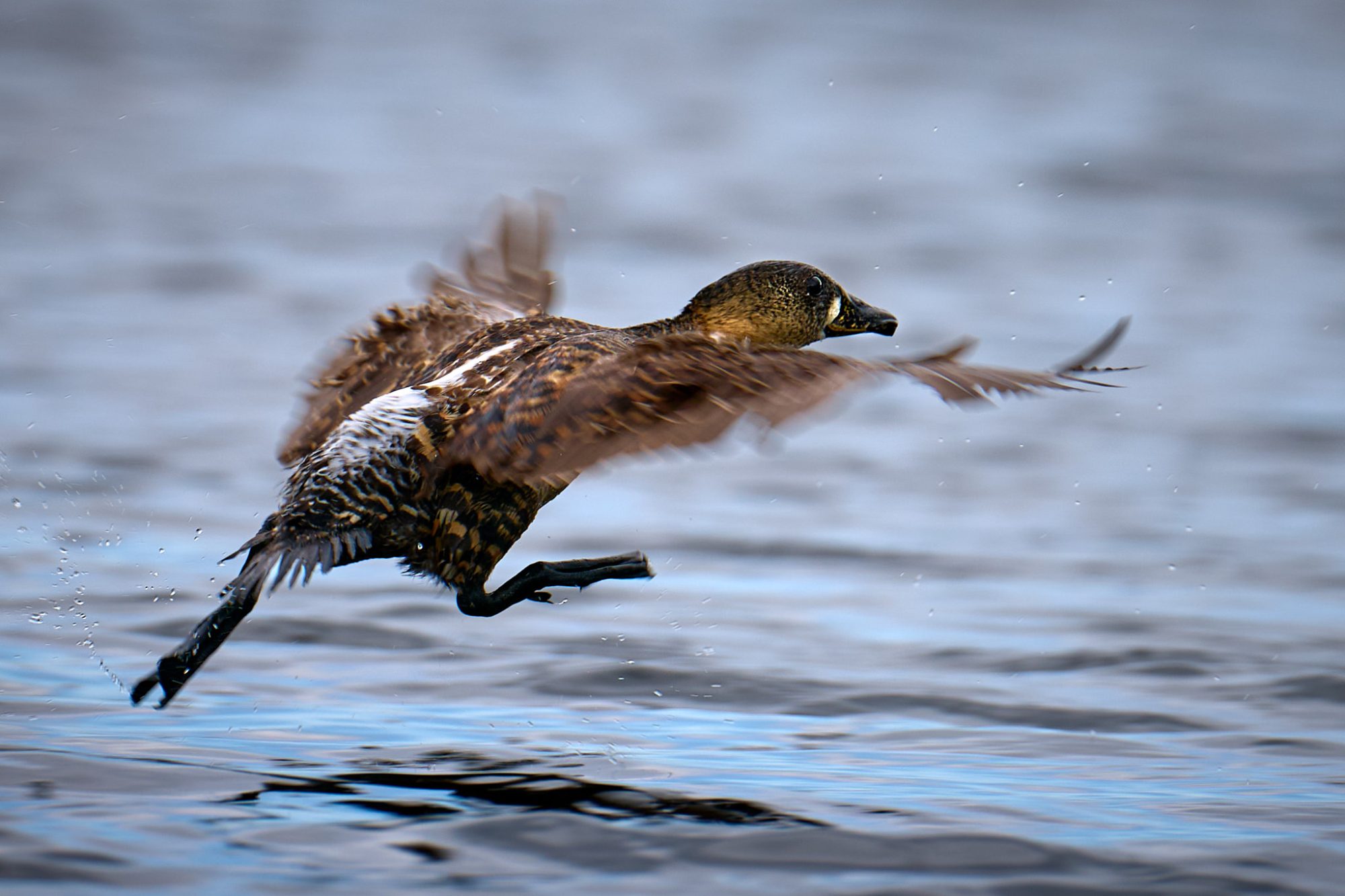
White-backed Duck in flight Image supplied by Dave Dooley
Q: What’s the biggest mistake photographers make when shooting birds in flight?
Reacting instead of anticipating. Everything else flows from that single failure. The photographer who waits until the bird is airborne before raising the camera has already lost the shot.
Not knowing the bird – A photographer without species knowledge arrives hoping something will happen. A prepared photographer knows what is going to happen, when, and from which direction.
Not reading pre-flight signals – Defecation, feather compression, head scanning, weight shift — all visible and readable well before launch. A photographer watching their screen rather than their subject will miss every one of them.
Incorrect aperture for flight – Setting aperture for a perched bird and failing to adjust for the depth of field required in flight is extremely common. The wings extend beyond the depth of field and the wingtips are soft.
Tracking acquired too late – Attempting to acquire focus lock on a bird already in motion is unreliable. Focus must be locked on the perched bird and held through the launch sequence.
Clipped wings – Shooting too close without considering full wingspan extension is one of the most avoidable errors in bird-in-flight photography. A clipped wingtip tells every informed viewer the photographer was not ready.
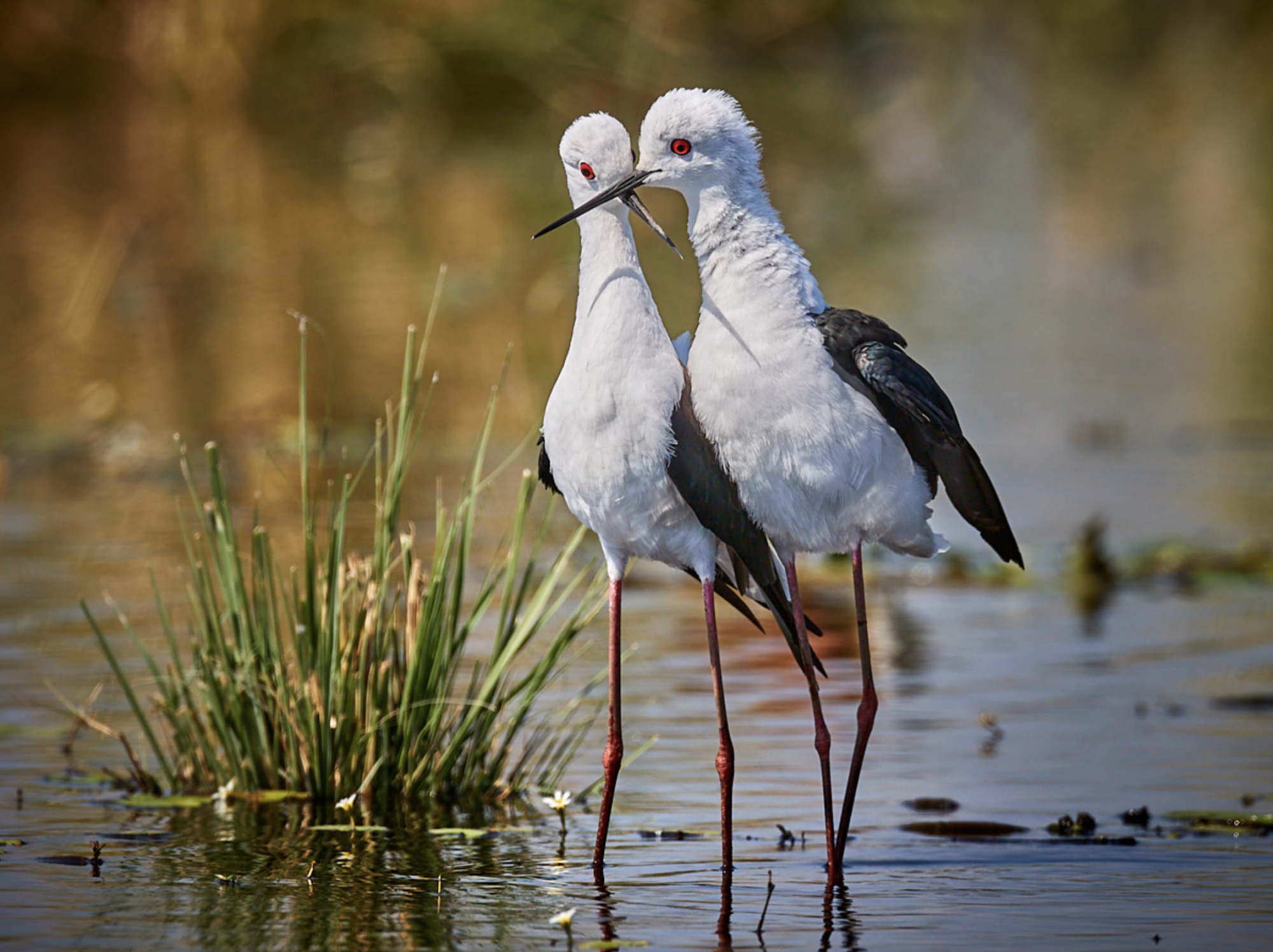
Black Winged Stilt pair courting Image supplied by Dave Dooley
Dealing With The Unexpected
Not everything can be predicted. Some of the most memorable images come from moments that arise without warning – where instinct, experience, a measure of patience and preparation meet opportunity.
Q: What’s the most unusual or memorable bird behaviour you’ve witnessed on the Chobe?
Three moments stand out — each one the kind of encounter that reminds you why patience and preparation matter.
The first was Black-winged Stilts mating. My guide, who had lived and worked on the river his entire life, had never witnessed it before. That alone speaks to how rare the event is. Being positioned correctly to photograph it was equal parts field craft and fortune.
The second was African Skimmers mating in daylight. Skimmers are predominantly nocturnal in their mating behaviour — witnessing and photographing the event in usable light is something most Chobe photographers will never experience.
The third was a White-backed Duck in flight — a genuinely uncommon sight. Most photographers only ever capture this species on the water, where its folded wings conceal the distinctive white back plumage entirely. What made the shot particularly satisfying was that my camera was already configured for motion blur before I spotted the bird. The resulting image was not only behaviourally rare but a strong example of intentional motion technique — proof that preparation for one type of shot can unexpectedly serve another.
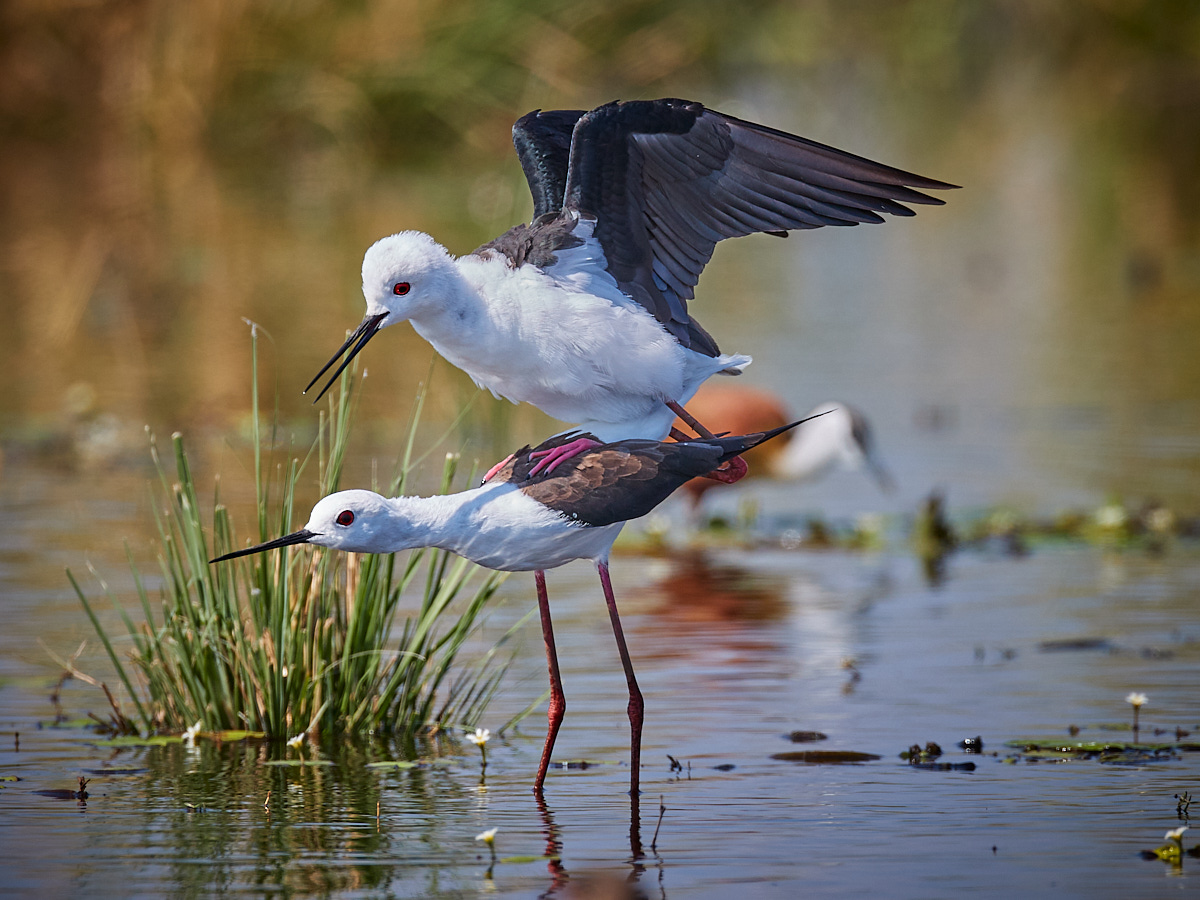
Black Winged Stilts copulating Image supplied by Dave Dooley
Q: Have birds ever reacted to the boat in ways that surprised you?
Yes, and the most memorable example involved a species known for being the opposite of cooperative.
African Pygmy Geese are extraordinarily skittish. Under normal circumstances they will flush at 100 metres or more at the first sign of boat movement. On this occasion my guide Victor — who knows the river and its birds with a depth that only a lifetime on the water produces — cut the motor well before we were within the bird’s typical flush distance. He then used an oar to punt the boat forward in absolute silence, closing the distance metre by metre without creating a bow wave or any mechanical sound.
We reached 10 metres. The bird held. The result was a pin-sharp image of a species that most photographers never manage to photograph at anything approaching that distance. It was a reminder that the guide’s knowledge and patience is as integral to the final image as any decision made behind the lens.
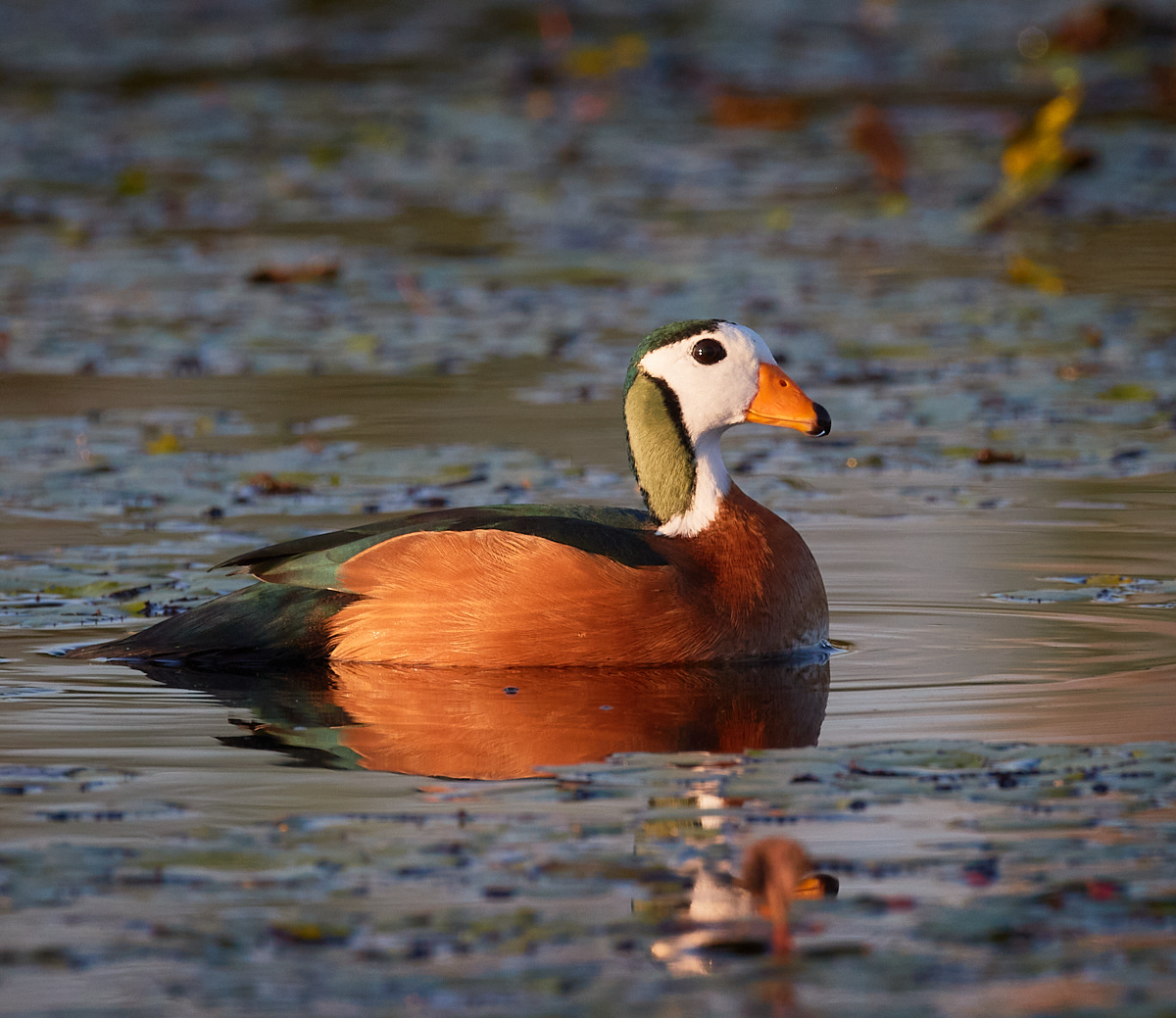
African pygmy goose reflections Image supplied by Dave Dooley
Q: Is there a moment you almost didn’t shoot but did, and it paid off?
Late afternoon, and I was beginning to pack away. The light was low and I had already concluded that the day’s shooting was done.
Then the golden hour arrived with unusual intensity — the setting sun casting a warm glow across the water that I had not anticipated. A Reed Cormorant appeared, flying directly toward the boat. I made a last-minute decision to raise the camera.
The bird spread its wings and landed on the water ahead of me. The silhouette was clean against the gold. The backlit illumination caught the edges of the feathers, creating a rim-light effect through the plumage. The water droplets from the landing reflected the light directly into the lens.
It remains one of the strongest images I have taken on the Chobe — and it very nearly did not happen. The lesson is straightforward: pack away only when the light is genuinely gone, not when you think it is.
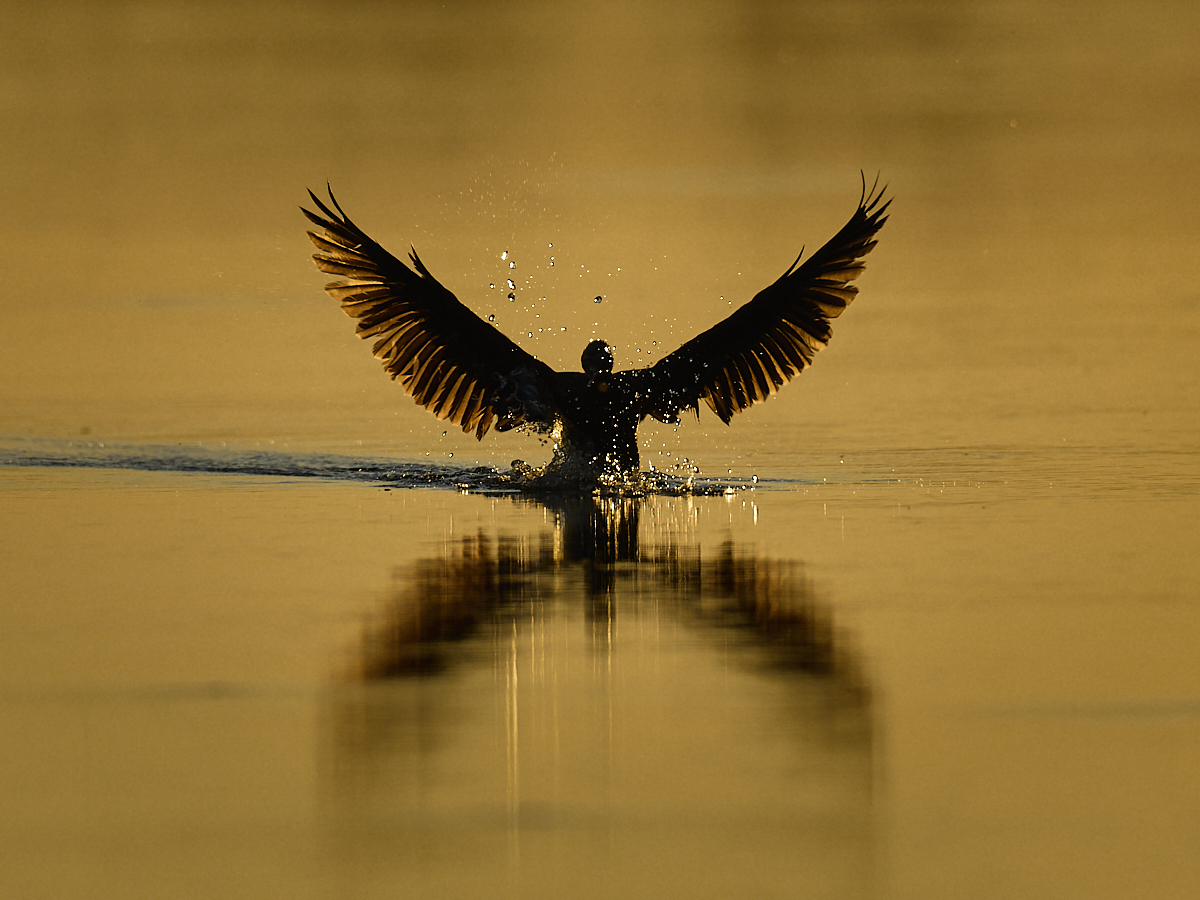
Reed Cormorant silhouette Image supplied by Dave Dooley
Philosophy & Perspective
Bird photography moves beyond settings and technique into something far more instinctive. What follows is not about the camera, but about how a photographer begins to see, anticipate, and respond.
Q: At what point does bird photography stop being technical and become instinctive?
When you stop thinking about the camera and start thinking only about the bird.
Every technical discipline — exposure, aperture, shutter speed, tracking, gimbal technique, pre-flight signals, wind reading, boat positioning — begins as a conscious, deliberate process. With sufficient time and repetition, those decisions migrate from conscious thought to muscle memory. Shutter speed is adjusted without looking at the dial. Aperture is set for flight before the bird has shown any intention of moving. The histogram is read peripherally. Pre-flight signals register immediately and without analysis.
The paradox
Instinctive photography is not the absence of technical knowledge. It is its complete internalisation. The photographer who has never mastered the fundamentals will never achieve genuine instinct — they will simply be guessing quickly.
On the Chobe specifically
The river accelerates that process because it removes the safety nets available on land. Every variable is in motion simultaneously. Photographers who spend serious time on the Chobe develop instinct faster than in almost any other environment — because the environment demands it.
Q: If someone leaves this blog with one lesson, what should it be?
Know your subject. And have the patience to wait for it.
Every technical discipline in these pages is rendered largely irrelevant if the photographer does not intimately understand the behaviour of the bird in front of them. Equipment does not make a bird photographer. Anticipation does. And anticipation is impossible without knowledge.
The photographers who consistently produce exceptional work on the Chobe are not those with the most expensive cameras or the longest lenses. They are the ones who arrived having studied their subject — who understand how a Fish Eagle hunts, how a Heron signals its intention to fly, how wind direction determines a bird’s takeoff trajectory. That knowledge cannot be purchased. It is built through research, observation, and time in the field.
But knowledge alone is still not enough. The final and most underrated quality in bird photography is patience. Not passive waiting but rather active, alert, prepared patience. The kind that keeps your focus locked on a perched bird for forty minutes because you know the moment is coming. Where you can hold concentration through long periods of inactivity without allowing attention to lapse for the thirty seconds that matter. Practiced patience that accepts a full day of ordinary frames without frustration, because experience tells you the exceptional frame is being earned rather than missed.
Without patience, knowledge is wasted and technique is irrelevant. A photographer who cannot wait will never be in position when the moment arrives. On the Chobe, as in all serious bird photography, the river will test your patience before it rewards it.
Master the science. Learn the bird. Cultivate the patience. The images will follow.
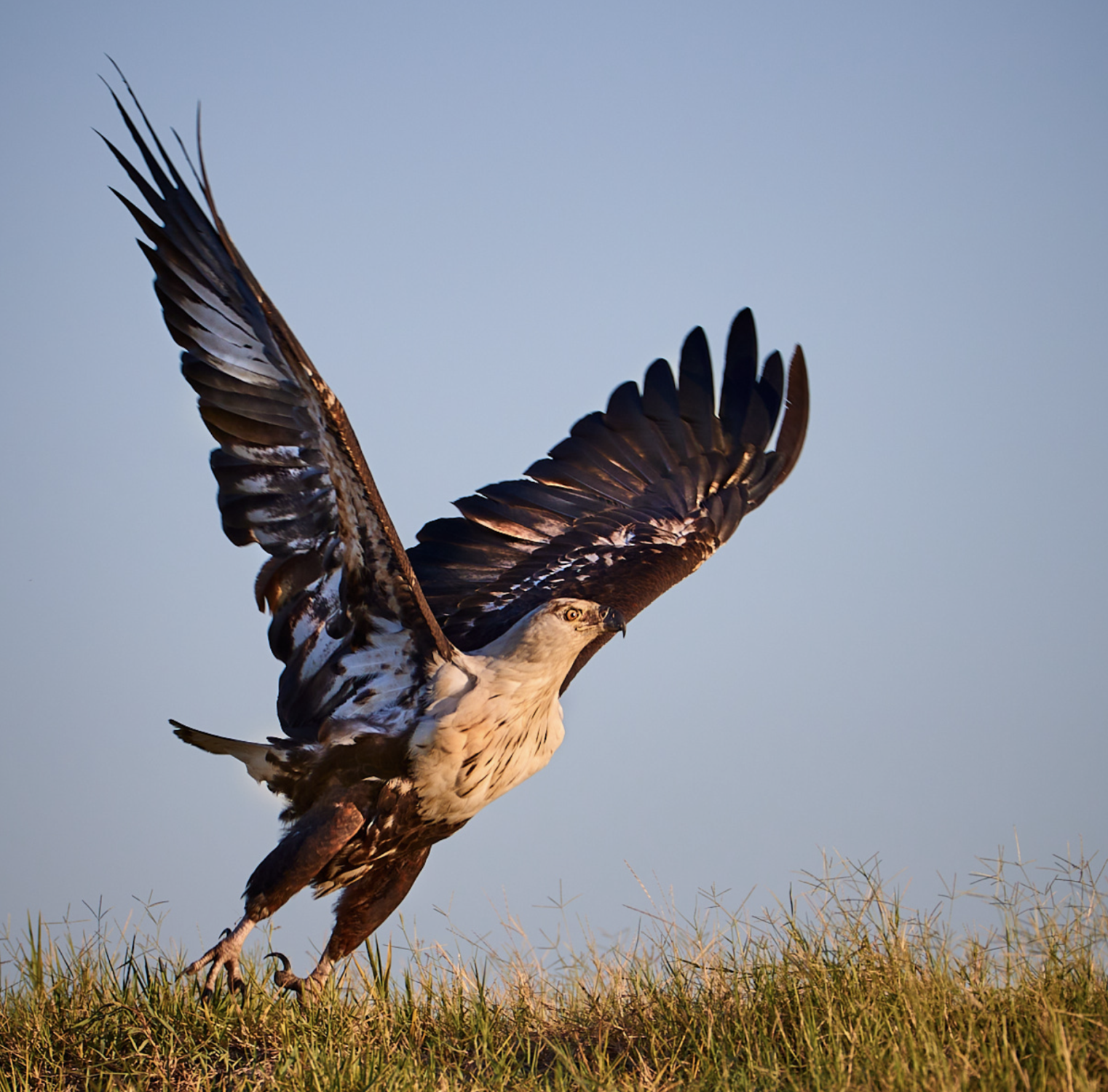
Juvenile Fish Eagle taking flight. Image supplied by Dave Dooley
Acknowledgements & Coming next in the series
We would like to extend our sincere thanks to Dave and Peter Dooley for the generosity of their time, their insight, and the care with which they share their craft. Their approach is both meticulous and deeply human, and it is a privilege to learn from them. Most of all, we are grateful that they continue to choose to return to the Chobe and to our properties, bringing their passion, patience, and excellence back with them each time. A highlight is seeing selections of their favourite images captured that they generously share with our team – Thank you!
In future blogs, we will go deeper into the Dooleys’ specialisations: Dave’s bird photography masterclass on the Chobe, and Peter’s approach to landscapes, atmosphere, and making images in unexpected places.
Related Topics:
The Chobe That Never Disappoints
© David Dooley and Peter Dooley (2026). All rights reserved.
All photographs, text, and visual content on this website are protected by copyright. No part of this blog – including images, written content, or graphics – may be copied, reproduced, published, stored, transmitted, or used in any form or by any means (electronic, mechanical, photocopying, recording or otherwise) without the express prior written permission of David Dooley or Peter Dooley. Permission is required for screenshotting or any other method of image capture.